

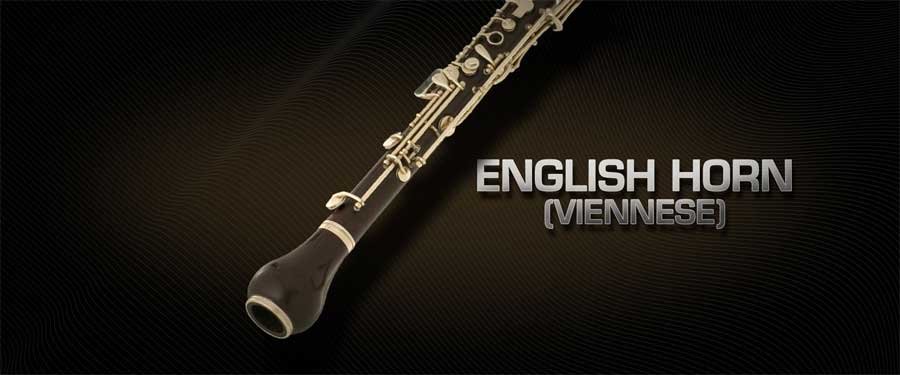
Das English Horn (Viennese) der Vienna Symphonic Library ist die perfekte Ergänzung zur Wiener Oboe und ein essenzieller Baustein für den authentischen „Wiener Klang“. Das Englischhorn ist das Alt-Instrument der Oboenfamilie (in F gestimmt) und bekannt für seinen melancholischen, tiefgründigen Charakter.
In der Wiener Bauweise unterscheidet es sich subtil von der französischen Standardbauart durch eine etwas andere Bohrung und Mechanik, was zu einem noch wärmeren und „holzigeren“ Timbre führt.
1. Der Klangcharakter: Nostalgie und Wärme
Das Wiener Englischhorn besitzt eine sehr spezifische emotionale Reichweite:
- Das Timbre: Es klingt etwas dunkler und weniger „nasal“ als die französische Variante. Sein Ton ist voll, cremig und besitzt eine wunderbare Tragfähigkeit in der Mittellage.
- Die Tiefe: In den unteren Registern ist es besonders sonor und kräftig, was es ideal für geheimnisvolle oder pastorale Themen macht.
- Die Höhe: Selbst in den höheren Lagen behält das Wiener Modell seine Rundung und wird nicht dünn, was für sehr gesangliche, lyrische Linien sorgt.
2. Einsatzgebiete
- Spätromantik: Unverzichtbar für die Werke von Mahler, Bruckner oder Richard Strauss. Wenn du den spezifischen Klangkörper dieser Ära rekonstruieren willst, ist das Wiener Modell die authentischste Wahl.
- Pastorale Momente: Der klassische Einsatz für das Englischhorn (denk an den Solopart aus Dvořáks 9. Sinfonie „Aus der neuen Welt“). Das Wiener Modell verleiht diesen Stellen eine zusätzliche Bodenständigkeit.
- Filmmusik: Ideal für einsame, sehnsuchtsvolle Soli, die eine europäische, klassische Eleganz ausstrahlen sollen.
3. Artikulationen & Realismus
Die VSL-Library fängt die physische Komponente des Instruments hervorragend ein:
- Performance Legato: Da das Englischhorn ein größeres Rohrblatt als die Oboe hat, ist die Luftführung träger. VSL bildet diese trägen, aber extrem geschmeidigen Bindungen perfekt ab.
- Vibrato-Kontrolle: Enthalten sind verschiedene Stufen von Vibrato, die typisch für den kontrollierten Wiener Spielstil sind – subtil, aber ausdrucksstark.
- Portato & Sustains: Besonders die sanften Notenansätze sind meisterhaft gesampelt, sodass das Instrument förmlich aus der Stille „hineinschweben“ kann.
4. Integration: Silent Stage & Synchronized
- VI Series (Silent Stage): Staubtrocken aufgenommen, bietet es die maximale Flexibilität. Mit MIR Pro platziert man es idealerweise im Wiener Konzerthaus oder dem Musikverein, um den natürlichen Lebensraum dieses Instruments zu simulieren.
- Synchronized English Horn (Viennese): Diese Version nutzt die trockenen Samples, bettet sie aber direkt in die Akustik der Synchron Stage Vienna ein. Im Synchron Player fügt es sich nahtlos in moderne Orchester-Templates ein.
5. Technische Übersicht
| Merkmal | Details |
| Stimmung | In F (klingt eine Quinte tiefer als notiert) |
| Klangbild | Dunkel, melancholisch, voll, weniger nasal |
| Besonderheit | Spezielle Wiener Bauweise für maximale Wärme |
| Empfehlung | Das Soloinstrument für tief-emotionale, lyrische Passagen |
Fazit: Das VSL English Horn (Viennese) ist die ideale Wahl, wenn das „Standard-Englischhorn“ zu hell oder zu dünn klingt. Es bringt eine noble Schwere und eine nostalgische Tiefe in deine Arrangements, die besonders in kleineren, intimen Besetzungen ihre volle Wirkung entfaltet.
Nie war eine Orchester-Library so gut [...], nie gab es so viele, qualitativ höchstwertige Samples in Verbindung mit einem intelligent gemachten Sampleplayer. Gerade letzterer stellt nicht nur für alle Computer-Orchestratoren einen großen Sprung nach vorne dar, sondern er festigt auch die Positionierung von VSL als Speerspitze technischer Innovation gepaart mit orchestraler Authentizität gegenüber der Konkurrenz.
Martin Gerke, Sound & Recording, März 2007
While Woodwinds I is fine for basic woodwind arrangements, certain instruments on Woodwinds II are indispensable for serious orchestral work. The combined cost of the two collections is hefty, but quality usually comes at a price; if you need a comprehensive woodwind section capable of every musical nuance under the sun, the pair offer an immaculate solution.
5 Stars, Sound on Sound, November 2006
It’s fair to say that Vienna Instruments are pushing the boundaries of how sampled instruments sound and play. Offering unprecedented control over articulations and expression, VSL’s Vienna Instruments afford professional composers and mockup masters with one of the most comprehensive and sophisticated instruments on the market. The recording quality is uniformly excellent, the performances are consistently superb, and the range of articulations is exhaustively comprehensive.
John Krogh, Keyboard, August 2006
The Vienna Instruments combine full instrumentation with the greatest musical depth of any orchestral sound library. The Vienna Instruments Player has the power to make orchestral samples sound more realistic than ever before, and its highly flexible switching system reduces the strain of setting up arrangements.
Dave Stewart, Sound on Sound, July 2006
Sometimes it’s hard to believe that you’re actually playing what you hear – the transitions are that smooth. Nothing else can do that. [The player’s] interface is very clear, and it takes no time to learn your way around it. I was able to load 1.745 GB of samples into the 2GB installed on the Windows machine, which is absolutely phenomenal – over half a gig more than anything else has ever loaded on that computer. Still subjectively, VSL’s greatest strength – apart from the subtlety of expression you’re able to achieve with such a vast selection of articulations – is somewhat intangible: the notes all have a meaning. This especially true for the short woodwinds; rather than just going “toot”, their possibilities are immediately obvious. All the major software samplers have improved by leaps and bounds in many important areas, but they haven’t necessarily focused their efforts on making the wonderful new libraries they spawned easy to manage. The Vienna Instruments player sets new standards in that category, and also in its memory access performance. That, combined with the incredible breadth of the library itself, allows you to do some things nothing else can do.
Nick Batzdorf, Virtual Instruments Magazine June/July 2006
Firma: Vienna Symphonic Library